AUDIOBOOK
About
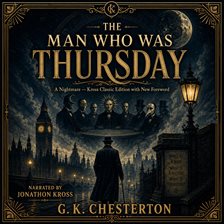
A thriller about a council of anarchists named for the days of the week - and
one of the strangest novels in English.
Gabriel Syme, a poet recruited by Scotland Yard, infiltrates a secret council of
seven conspirators. One by one he discovers his fellow anarchists are not what
they seem. What begins as a chase through Edwardian London bends, chapter by
chapter, into something closer to nightmare, and then into something stranger
still.
Chesterton subtitled it A Nightmare, and insisted afterwards that it was not a
defence of anything but a description of his own escape from a young man's
despair. The Sunday of its closing pages - enormous, terrible, somehow
benevolent - is what he came to believe reality was actually like underneath.
Its admirers have been many and unlikely. Borges called it one of the great
fantastic novels. Michael Collins carried it in his pocket. C. S. Lewis read it
as an undergraduate and never quite recovered. Orson Welles adapted it for radio
in 1938 - a reminder that Chesterton wrote in a voice built for speaking aloud,
where the paradoxes land like spoken jokes and the arguments play as conversation.
Includes a new foreword by Alexander Kross.