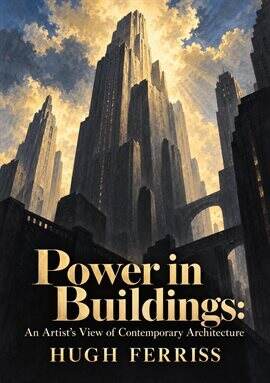
Power in Buildings: An Artist's View of Contemporary Architecture by Hugh Ferriss
There are buildings that do not merely stand but speak, structures that rise from the earth with such deliberate force that they seem to breathe with intention. Hugh Ferriss understood this language long before the rest of the world caught up. One of the twentieth century's most visionary architectural illustrators, Ferriss spent decades translating stone, steel, and glass into something far more elemental, capturing not just the surfaces of buildings but the soul burning beneath them. Power in Buildings is his testament to that lifelong pursuit, a sweeping meditation on what it means to construct not just a shelter but a statement, not just a form but a philosophy. This is a book that dares to ask what architecture truly is when stripped of its blueprint and left to stand naked before the human eye.
Ferriss moves through the architectural landscape of mid-century America with the eye of a poet and the precision of a draftsman, finding drama in the soaring verticality of skyscrapers, quiet menace in shadowed facades, and unexpected grace in the tension between raw industrial ambition and human scale. His drawings, brooding and atmospheric, pull readers into a world where buildings become protagonists, where concrete carries emotional weight, where the act of construction becomes inseparable from the act of imagination. The pages carry an almost cinematic quality, as though each illustration is a single frame from a film about civilization reaching for something just beyond its grasp. Ferriss does not celebrate architecture from a distance. He inhabits it, and he invites the reader to do the same.
For anyone captivated by design, urban culture, creative vision, or the sheer audacity of human ambition rendered in physical form, Power in Buildings delivers an experience that few volumes can match. It reshapes how a reader walks through a city, how they tilt their head back to regard a towering facade, how they understand the silent conversation between a building and its observer. Architects, artists, historians, and dreamers will find in these pages not just a record of what was built in twentieth-century America but a profound argument for why it matters. Ferriss reminds us that every great building is, at its heart, an act of will, and that recognizing that will is the first step toward understanding the world we have made for ourselves.