Books, videos, and music - all free from your public library!
LoginSign Up

Footer

Hoopla logo, Go to homepage
  • For Patrons
  • For Libraries (opens in new window)
  • For Vendors (opens in new window)
  • Facebook (opens in new window)
  • X (opens in new window)
  • Instagram (opens in new window)
  • YouTube (opens in new window)
  • TikTok (opens in new window)
  • LinkedIn (opens in new window)

Our Company

  • Our Story
  • Get Hoopla for your Library (opens in new window)
  • Get your content on hoopla (opens in new window)
  • Join our team (opens in new window)
  • Accessibility Statement

Our Content

  • Audiobooks
  • Ebooks
  • Movies
  • Television
  • Comics
  • BingePasses
  • Music
  • The Loop Blog

Help

  • Help Center
  • Submit Feedback
  • Facebook (opens in new window)
  • X (opens in new window)
  • Instagram (opens in new window)
  • YouTube (opens in new window)
  • TikTok (opens in new window)
  • LinkedIn (opens in new window)
  • Download on the App Store (opens in new window)
  • Get it on Google Play (opens in new window)
  • Available at Amazon Appstore (opens in new window)
© 2026 Midwest Tape, LLC. All rights reserved. Privacy Policy | Terms of Use
  • Hoopla logo
  • Browse
  • My Hoopla
  • Log In
  1. Navigate Home
  2. Ebooks
  3. Who Needs a New Covenant?

EBOOK

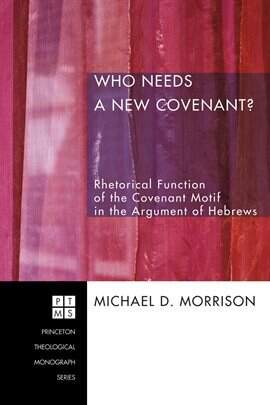
Who Needs a New Covenant?

Rhetorical Function of the Covenant Motif in the Argument of Hebrews

Michael D. MorrisonSeries: Princeton Theological Monograph
(0)
sign up
Pages
226
Year
2008
Language
English
Publisher
Wipf and Stock Publishers

About

Although covenant is a major theme in Hebrews, Morrison contends all mention of covenant can be deleted without damaging the coherence of the epistle or its Christological conclusions. What role, then, does the covenant motif have in the epistle?

The arguments in Hebrews are aimed at a Jewish audience-they ignore the needs and religious options relevant to Gentiles. For the readers, the Sinai covenant was the only relevant conceptual competitor to Christ.

First-century Jews looked to the Abrahamic and Mosaic covenants as the basis of their obligations to God and God's promises toward them. Although most Jewish writers merged these covenants as if they were one, the author of Hebrews does not-he retains the Abrahamic promises while arguing that the Mosaic covenant is obsolete.

The covenant concept supports the exhortations of Hebrews in two ways: 1) it provides the link between priesthood, worship rituals, and other laws, and 2) it enables the author to argue for allegiance to the community as allegiance to Christ.

Related Subjects

  • General (Religion)
  • Religion
  • Adult Nonfiction
  • General (Biblical Criticism & Interpretation)
  • Biblical Criticism & Interpretation
  • Exegesis & Hermeneutics
  • Biblical Studies
  • General (Biblical Studies)

Extended Details

  • SeriesPrinceton Theological Monograph #85

    Artists

    Michael D. MorrisonAuthor